Showing posts with label Sebastian Fudora. Show all posts

Thursday, January 27, 2022

Twelve to Watch for 2022

With the new boxing year now underway, I made a list of current fighters whom I love watching ply their trade. I then separated my list into two categories: champions or former champions in the first bucket and those who have yet to fight for a title in the second grouping. This article will cover 12 fighters from this second group; many of them are poised to have a big 2022. 

There's no real rhyme or reason or consistent theme for the boxers who appear on this list (although they all have fewer than 20 professional bouts), just fighters who have caught my eye. I won't say that these 12 are the best at anything yet, but they all have intriguing potential, solid skill sets and are generally entertaining in the ring. Some of these names will be more familiar to you than others, but all are worth keeping tabs on. And with that, here's the 12.    

Ra'eese Aleem (19-0, 12 KOs, junior featherweight, Age 31, USA)
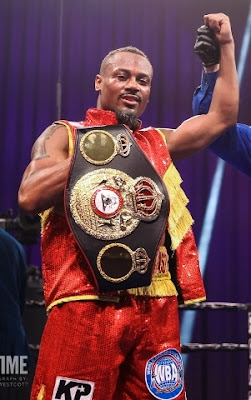
Photo courtesy of Amanda Westcott

Aleem opened eyes last year with a masterful performance against Vic Pasillas, although he did have a more challenging fight against rugged opponent Eduardo Baez later in the year. Even though he's not a young fighter (31), he was still fighting on club shows as recently as two years ago. But as he has demonstrated in his past three fights on Showtime, Aleem possesses world-class talent. More than that, he can be a stylistic nightmare. Comfortable switching stances even during the middle of a combination, Aleem has an unpredictability that will make him competitive with anyone in the junior featherweight division. He has knockout power in both hands and features choppy movement that doesn't fall into regular patterns. One thing he needs to watch out for is a problem that many movers face: over-movement. He tries to do so many things at times, especially in close quarters, that he can find himself out-of-position for straight shots and counters.   

Jared Anderson (11-0, 11 KOs, heavyweight, Age 22, USA)

Anderson is the best heavyweight prospect in America. And although that sounds like high praise, it isn't. He might be the only one who could actually win a title. But being the best of a mediocre bunch isn't why he's on this list; Anderson has earned it. In multiple training camps with Tyson Fury, Anderson, by all reports, has given the heavyweight champion great work. He has stopped all 11 of his professional opponents, but he has more than just one-punch power. He features a relentless body attack that is uncommon for a young and tall (6'4") heavyweight. In addition, he's very comfortable fighting out of each stance. He also throws punches in combination and doesn't load up on one shot. As he hasn't gone past the sixth round yet, Top Rank needs to test his endurance this year. Anderson has tons of heavyweight tools, but he still has a few rungs to go up the ladder. There's no rush, but let's hope we can see some real progress in 2022.  

Felix Cash (14-0, 10 KOs, middleweight, Age 28, UK) 
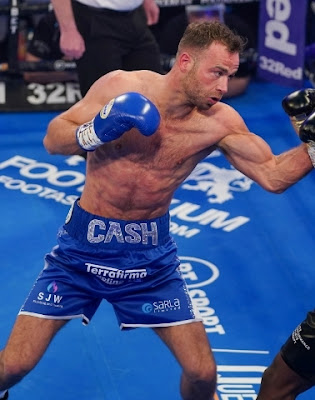
Photo courtesy of Queensberry Promotions

The middleweight division has been lackluster in recent years. It's thin and the top guys haven't been in a rush to face each other. Those looking past the familiar names in the division might be interested in this potential sleeper. Cash was a solid amateur in the UK, has a great professional trainer in Tony Sims and has disarming power. In 2021 he knocked out fellow undefeated British prospect Denzel Bentley in three rounds. Cash can box and punch and has power from all ranges. It remains to be seen how he fares against superior athletes or those who try to muscle him on the inside, but make no mistake, he knows how to handle himself in the ring. Expect Cash to get an opportunity against a top-15 fighter in 2022. He could move fast – the division is weak and everyone is on the hunt for fresh faces.  

Charles Conwell (16-0, 12 KOs, junior middleweight, Age 24, USA)
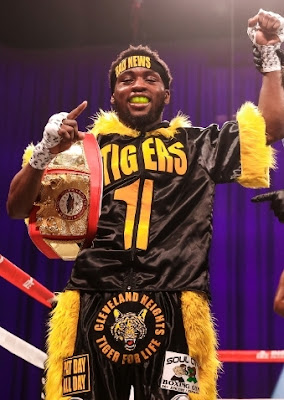
Photo courtesy of Amanda Westcott

We don't often think of recent U.S. Olympians as wrecking balls in the ring, but that's what Conwell is. With a swarming style similar to Shawn Porter and Tim Bradley, but with more power than both, the 2016 Olympian is poised for big things in the sport. 2021 was mostly a marking time year for him with two fights against non-descript opponents; however, the junior middleweight division could soon have a bunch of titles available in the near future. Conwell could have some significant opportunities in the next 18 months. There are a couple of in- and out-of-the-ring concerns regarding his advancement. His defense still needs to be tightened up on the inside and his management (Split-T) is going through a variety of issues at the moment. Hopefully he will have a clear direction and at least one fight of real significance in 2022.   

Keyshawn Davis (4-0, 3 KOs, lightweight, Age 22, USA)

Davis is one of the more unusual prospects I've seen in recent years. He places his punches with patience and utmost care. Despite having athleticism and power, he's not in any rush in the ring. He seems wise beyond his years. A silver medalist in the Tokyo Olympics, Davis has also been a frequent sparring partner for champion Shakur Stevenson. Even with only four professional fights, Davis has pedigree, polish, and a number of veteran fighter skills. It will be interesting to see if he does possess the types of youthful flourishes that create new boxing fans. Does he have a killer instinct? Does he know when to turn on the jets? They say that youth is wasted on the young, but sometimes the young aren't burdened by caution. Let's see what's in store for Davis. To say that I'm intrigued by Davis is a massive understatement. 

Sebastian Fundora (18-0-1, 12 KOs, junior middleweight, Age 24, USA)
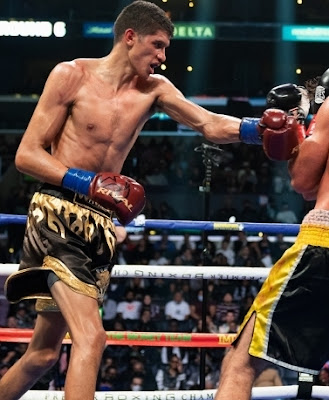
Photo courtesy of Esther Lin

The 6'5" southpaw junior middleweight (although he might actually be taller) is no longer a secret in boxing circles. Having been featured prominently on several PBC broadcasts over the last few years, Fundora is a unicorn in boxing. There's just no one like him in the sport. Not only is he five inches or so taller than almost everyone in the division, he also loves to fight inside and mix it up. Despite looking like a toothpick in the ring, he's actually a banger and a bruiser. He has deceptive toughness and physicality. But being unique isn't the same as being unbeatable. He had a draw with Jamontay Clary in 2019 and Sergio Garcia gave him a really hard time in his last fight. It's clear that Fundora would rather face brawlers than more disciplined and technical fighters. He has periods where he sometimes zones out and loses focus. He's rumored to face Erickson Lubin next in what could be one of the best fights in the first half of 2022.  

Bakhodir Jalolov (9-0, 9 KOs, heavyweight, Age 27, Uzbekistan)

The Tokyo Olympics super heavyweight champion, Jalolov has a powerful left hand, a sharp right hook and a natural ability for combination punching. The southpaw uses range well and can move, but some have questioned his gas tank, even in amateur three-round fights. He's still at least two years away from title contention, but he could move up the ladder fast. In 2022 he's going to need real opponents who will force him to go rounds. His knockouts and ring IQ will take him far, but more will be needed to round out his entire package in the ring. He's one of the best heavyweight prospects in the sport and he possesses an intriguing mix of power, skills and ring smarts.   

Frank Martin (15-0, 11 KOs, lightweight, Age 27, USA)

Martin opened eyes in 2021 by knocking out Jerry Perez in a battle of unbeaten prospects. Martin has also already fought in 2022, stopping veteran trial horse Romero Duno in four rounds on New Year's Day. Martin is highly skilled. A southpaw with great feet and excellent boxing acumen, he has power in both hands and the ability to land different punches for knockout blows. Fighting out of Derek James' gym in Dallas, Martin can box, but he has a nasty streak as well. Through 15 professional fights, Martin has barely lost a round. He's going to be a nightmare to outbox and he can hurt opponents too. Martin's recent opponents have been capable, but he's yet to face a solid combination puncher or a supreme athlete. We still need to see how good his defense is. His offense is already there.  

Artem Oganesyan (12-0, 10 KOs, junior middleweight, Age 23, Russia but fights out of Canada)

For those looking for a fighter who's a little off-the-grid, let me suggest Oganesyan. When doing research for a Ring City piece last year, Oganesyan hit my radar, and I became enthralled with his abilities. A southpaw with great feet, he's fantastic off the back foot, but he also can be aggressive when the situation calls for it. He's a pure boxer with pop, featuring hand speed, smooth movement and a high Ring IQ. Oganesyan isn't aligned with a huge promoter and didn't even fight in 2021, but he's certainly another of the young guns at 154 lbs. who could soon become a major factor in the division (Conwell and Fundora are also on this list). It's still to be determined just how big of a puncher he is. His knockouts are more a product of the accumulation of clean blows than one-punch finishing ability.  

Jesse "Bam" Rodriguez (14-0, 10 KOs, junior flyweight, Age 22, USA)

Rodriguez has footwork that may be on par with Lomachenko's, except it may even be more purposeful. Possessing speed, athleticism, power, a large punch arsenal and expert accuracy, Rodriguez is a young fighter who has genuine pound-for-pound ability. Trainer Robert Garcia has called him the best fighter in his gym and while that might sound like hyperbole considering Rodriguez's relative inexperience, let's not discount it either; he could be that good. Rodriguez is an aggressive southpaw with a rock-solid boxing foundation. Although he's definitely a knockout puncher, he doesn't force stoppages. His abilities have overwhelmed opponents to this point. It's still not clear if he's going to settle at 108 or 112 lbs., but he has the talent level to win a world championship in either division. It's going to come down to the sanctioning bodies for him, since champs won't be lining up to give him an opportunity. 

Gary Antuanne Russell (14-0, 14 KOs, junior welterweight, Age 25, USA)
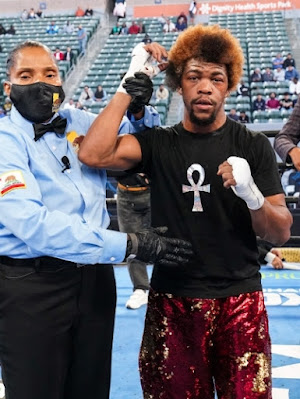
Photo courtesy of Esther Lin

Yet another southpaw on this list, Russell mixes in blinding hand speed with significant punching power and spite. A brother of Gary Russell Jr.'s, Antuanne has a strong amateur pedigree, and seems to be more offensively-minded than his brother. In a perfect world Russell would be more active; he had only one fight in 2021 and one in 2020. I think that the only thing that Russell needs to improve on is his punch accuracy. He could sacrifice a little bit of speed to hit the target more frequently. A natural combination puncher, he could have even more success if he places his punches a little more carefully. He's a prime candidate to win a junior welterweight belt once Josh Taylor leaves the division.  

Dalton Smith (9-0, 7 KOs, junior welterweight, Age 24, UK)
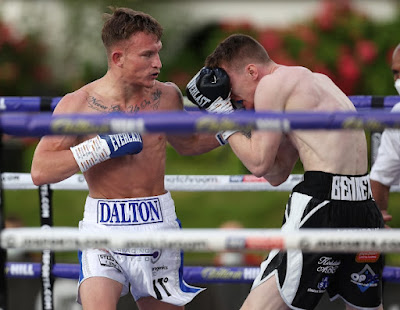
Photo courtesy of Mark Robinson

Smith represented Great Britain in various amateur tournaments and in the World Series of Boxing. Trained by his father, Grant (who also corners champion Sunny Edwards), Smith has an impressive boxing foundation. And what separates him from many prospects in the UK is that he can really punch. Watching him in the ring, he fights like a guy with far more seasoning than just nine professional fights; his poise is one of his best qualities in the ring. The challenge for Smith is to ensure that he is moved correctly. Matchroom had difficulties developing their 2016 Olympians appropriately and the hope here is that Smith can move fast, but not too fast. He still needs to face more opponents who will provide genuine resistance and will be in the ring expecting to win. Matchroom's matchmakers are going to be essential in his development. Let's hope that they get this one right. The talent is there.

Adam Abramowitz is the founder and head writer of saturdaynightboxing.com. He's a member of Ring Magazine's Ring Ratings Panel and a Board Member for the Transnational Boxing Rankings Board. 
snboxing on twitter. SN Boxing on Facebook. 

Monday, May 3, 2021

Catching My Eye: Ruiz, Parker, Edwards, Conlan, Fundora

Andy Ruiz paid the price for his recklessness early in Saturday's fight against Chris Arreola. Dropped in the second round by a chopping right hand and staggered multiple times in the third by quick counter left hooks, Ruiz, a prohibitive favorite coming into the fight, looked to be in danger of getting knocked out. Trying for the early stoppage, he was repeatedly reminded that lunging in with big shots was not a winning strategy for him.

Then, he took a deep breath, a step back, and decided to box from mid-range. Soon he gained control of the fight. Instead of throwing wild, wide power punches, he relied on his boxing fundamentals. He featured a stiff jab and some pinpoint combinations, including the 1-2-3 (jab/right hand/left hook), the jab to the body/straight right hand to the head, and the right to the body/straight left hook upstairs. 

Andy Ruiz (right) unfurls a right hand
Photo Courtesy of Sean Michael Ham/Fox Sports

By the end of the fight, there was no doubt that he was victorious. Ruiz learned two valuable lessons on Saturday. First, it was a reminder that this is heavyweight boxing and if you make mistakes, the other guy can send you to the canvas. Second, and perhaps even more important, was that Ruiz is not naturally a seek-and-destroy fighter, but a patient boxer with fast hands.

When Ruiz defeated Anthony Joshua in 2019 to win the heavyweight title, it was viewed as a monumental upset. After all, Ruiz was an overweight boxer with a seemingly indifferent attitude to the sport, whereas Joshua was a chiseled Adonis figure who had been a knockout wrecking machine. However, when watching Ruiz connect with his left hook on Arreola on Saturday, I was reminded of how he landed that punch on Joshua and how the hook led to Joshua's downfall.

Ruiz's left hook may be one of the best weapons in the heavyweight division. He whips it with a short trajectory and he lands it with pinpoint accuracy. It may not be the sheer destructive force that Deontay Wilder's right hand is, but make no mistake, Ruiz can land that punch on anyone in the division. 

Now with Eddy Reynoso, Ruiz will attempt to work his way back into the heavyweight title picture (his rematch loss to Joshua where he barely bothered to show up was a grave act of self-sabotage). Ruiz still doesn't have a great boxing body (although it looked better on Saturday), but he remains a threat in the division. He will always struggle with fighters who can work on the outside and have good feet, but in the pocket, he can compete with anyone. 

*

Joseph Parker won a heavyweight title in 2016 over Ruiz in a fight where I'm not sure that he deserved the victory. And that's a pattern. I don't think he won against Hughie Fury in a 2017 title defense and I'm not confident that he should have beaten Dereck Chisora on Saturday (although I did score it for Parker). 

Watching Parker in the second half of the fight on Saturday, he showed his considerable abilities. He could work in close or at distance. He was a fluid combination puncher. Parker threw every punch in the book. And he was very accurate. 

Parker beating the count in the first round
Photo courtesy of Mark Robinson

However, there was also a problem of the first three rounds of the fight and the 12th as well. He couldn't match Chisora's energy level or ferocity. He also didn't seem prepared from the opening bell. Chisora dropped him with an overhand right in one of the first punches of the fight. 

There remains a frustration level with Parker. He has the skills to be among the elite, but he could go life-or-death in the ring with anyone. Several key intangibles are missing from his overall package. He lacks a killer instinct. He also takes breaks during fights and often will display a blasé attitude in the ring. 

He's been fortunate. Parker is 29-2, but he could easily have five professional losses. And if a couple of other flips of the coin happened, he would not be considered a legit heavyweight contender, but more of a capable gatekeeper, not dissimilar to Dereck Chisora. 

Even with a trainer switch to Andy Lee for Saturday's fight, Parker has yet to display a consistent and comprehensive performance against a top-level boxer. Parker was a great heavyweight prospect, but it's time to push potential aside. The results speak for themselves. The Chisora fight, the Whyte fight, the Fa fight, the Fury fight – that’s who he is, a skilled fighter who doesn't have the ability or willingness to put 12 rounds together against a top opponent.

*

Backfoot fighters by and large are not beloved in boxing. Fans want to see entertainment and aggression. Even one of the four scoring criteria for each round, effective aggression, encourages fighters to come forward. However, there is no rule that says they must. 

On Friday, Sunny Edwards on his back foot dominated Moruti Mthalane, a longtime flyweight champ who hadn't lost since 2008. Edwards utilized the entire ring, moved left and right, switched stances effortlessly and landed at will. He hardly ever let the hard-hitting Mthalane plant his feet. Instead, Mthalane was chasing, lunging and missing. And Edwards would make him pay with quick, short combinations before exiting. 

Edwards with his belt after a dominant display
Photo courtesy of Queensberry Promotions

Edwards' trainer, Grant Smith, supplied perfect direction in the corner. He implored his fighter to keep combinations to two shots at most – longer sequences would give Mthalane more ability to find openings. Smith kept telling Edwards not to get greedy, get in and out. He also demanded that his fighter not remain stationary on the ropes, which would provide Mthalane a target. Edwards executed a terrific game plan and Smith did a wonderful job keeping him on task. It's always wonderful to see a fighter and trainer work in concert. 

Edwards doesn't possess a lot of power, but he has impressive strength. One thing I noticed during the fight is that when there were clinches, Mthalane tried to impose himself by putting his weight on Edwards and attempting to walk him back. But not only was Edwards prepared for that maneuver, he seemed just as strong in the clinch. And he was able to neutralize Mthalane's physicality. 

And that's where a crucial distinction must be made. Edwards may not be powerful, but he's not weak. He understands how others will try to beat him and will take that away from them. He will be a handful for any flyweight. To beat him, a fighter is going to have to sharpshoot from range, have a great ability to cut off the ring, or hope that Edwards gets overconfident and makes some mistakes. But if Edwards is as dialed in as he was on Friday, best of luck trying to beat that fighter. 

*

Michael Conlan is still only 15-0, but there's been no shortage of debate on his potential at the top level of the sport. Unfortunately for Conlan, he came out of the same Olympics, started at the same weight class and was signed to the same promotional company (Top Rank) as Shakur Stevenson. Within a few fights it was clear that Stevenson's athletic ability, natural talents and comparative youth (Stevenson is six years younger) would lead to a higher ceiling. And Stevenson has already won a world title at 126 lbs. and will soon be positioned to compete for a second title at 130. 

Meanwhile, Conlan has yet to face a true top-ten opponent and he recently moved down to 122 lbs., with his team believing that he perhaps didn't have enough power for the featherweight division. On Friday he faced Ionut Baluta, a legit gatekeeper at junior featherweight. Conlan would pass this test, although not comprehensively enough for some observers. 

Conlan has now been working with trainer Adam Booth for a number of fights and interestingly, Booth is emphasizing more of a front-foot approach for his fighter. Booth, who is often known for subterfuge, for wily, clever and indirect tactics in the ring, sent Conlan right after Baluta on Friday. And although Conlan may never be a one-punch knockout artist, he does hit hard to the body and many of his punches were thrown with real spite. 

Conlan wound up winning the fight by majority decision. In my opinion, the two judges who had it close gave Baluta a lot of credit for ineffective aggression; I thought that Conlan was the clear winner. 

Featuring impressive upper body movement and good feet, Conlan made Baluta miss big shots the entire fight; however, there were too many periods where he didn't return fire. So, if one fighter throws ten shots and lands one but the other guy throws four and lands two, it's certainly possible for the busier fighter to get credit, even if he's not particularly successful. 

Conlan will have to walk a very fine line to win a world title. He doesn't have fight-ending power. He can be outworked. But he can fight. It will all come down to potential opponents. He may be able to back-foot his way to a win against a slower-opponent, but the junior featherweight division is loaded with top talent. He wouldn't be favored against any of the current champions. 

With another fight or two before a title shot, it's very possible that Conlan could add another layer of polish. I believe he has been steadily improving. Will it be enough to win a world title? Perhaps not, but I wouldn't laugh that thought out of the room either.  

*  

Sebastian Fundora is a 6'6" junior middleweight who fights like an undersized 5'6" pressure fighter. It's not just that he gives up his height, he prefers inside combat. He knows how to fight up close. Fundora uses his body expertly to wear down opponents. He can impose his physicality along the ropes. Perhaps most impressively, he doesn't smother his work; he picks shots well against much shorter opponents.

On Saturday Fundora won a war against 154-lb. gatekeeper Jorge Cota. The two traded violent power punches all fight. Cota could not match Fundora's volume or accuracy, but he got through with a number of crushing right hooks and looping left hands. But, as well as Cota did, he didn't make it past the fourth round. 

Fundora is a unicorn, an anomaly. People his size aren't supposed to be in the junior middleweight division, and they certainly aren't supposed to fight inside. To this point, however, he has made weight with ease. It's not as if he's a super middleweight trying to squeeze down two divisions. 

Ultimately Fundora will thrive in boxing as long as his punch resistance remains strong. If he continues to fight in close and at mid-range, he will always provide a huge target for opponents, either to the head or the body. If he can take punches, he will be very tough to beat. But win or lose, he's a fantastic television fighter. And boxing can always use another member of that special club. 

Adam Abramowitz is the founder and head writer of saturdaynightboxing.com. He's a member of Ring Magazine's Ring Ratings Panel and a Board Member for the Transnational Boxing Rankings Board. 
snboxing on twitter. SN Boxing on Facebook.

Sunday, August 30, 2020

SNB Stock Report 8-30-20

After a busy month of fight action, it's time for another edition of the SNB Stock Report. See which fighters' stock went up (+), down (-) or remained unchanged (NC). To read more about the Whyte-Povetkin and Alvarez-Smith fights, click here. 

Shawn Porter (+)

Photo Courtesy of Sean Michael Ham

In his first ring action since last year's thrilling fight against Errol Spence, Shawn slugged his way to a shutout against Sebastian Formella. Porter dazzled with combination punching on the inside and exhibited solid technical boxing skills on the outside. This was always going to be a marking time bout for Porter, but he looked very sharp and didn't fight down to the level of his competition. Expect Porter to be back in the welterweight title picture in 2021.

Erislandy Lara (NC)

Erislandy Lara remains a formidable fighter in the junior middleweight division. This month he boxed his way to a unanimous decision against overmatched Greg Vendetti. Lara's timing was off at points early in the fight and he wasn't always able to stop Vendetti from getting in close. However, he got the best of the action with straight left hands, left uppercuts and right hooks. At 37, it's a fair question to ask if Lara's reflexes are still at their peak form, but we're going to need to see a much better opponent than Vendetti to find out that answer. 

Alfredo Angulo (-)

Many fight fans have been calling for Angulo to retire for a number of years. His physical skills have declined and he's taken far too many heavy blows. However, he had a nice come-from-behind victory against Peter Quillin last year, which was supposed to set up a meaningful fight against Caleb Truax. But Truax had to pull out of that matchup for health reasons and Angulo wound up facing late-replacement Vladimir Hernandez. After a slow start, Angulo slugged his way back into the fight, but he did slow down in the final two rounds. He wound up losing a unanimous decision, but more importantly, he was hit with hundreds of additional hard shots throughout the fight. He's now 38 and if he had been harboring any dreams of finding his way back into the title picture, that reality is now up in smoke.  

Angelo Leo (+)

Leo was supposed to fight Stephen Fulton for a vacant belt at 122 lbs., but Fulton tested positive for COVID-19 the week of the fight. Southpaw Tramaine Williams stepped in on short notice and despite a radical difference in opponent style, Leo was able to impress. Taking a few rounds to assess to Williams's hand speed and movement, Leo eventually had success on the inside with a merciless body attack. He also displayed an exceptional ability to cut off the ring, nullifying Williams's foot speed advantage. Leo won via a unanimous decision and put his name into the hat as another top fighter in the deep junior featherweight division. 

Ra'eese Aleem (+)

Every now and then an unheralded veteran fighter will suddenly emerge on the scene and force the boxing industry to take notice. Thirty certainly isn't an age for most junior featherweights to make an initial impression; that's when many smaller-weight fighters are already comfortably in their decline phase. However, Aleem, who had been boxing mostly in the Midwest and Pennsylvania circuits, made a significant statement by stopping Marcus Bates in his Showtime Championship Boxing debut. Aleem put forth an impressive power-punching display and he also demonstrated significant skills both on the inside and outside. With his electric performance, he'll certainly have another notable opportunity soon.  

Jose Ramirez (-)

Ramirez looked like he was in peak form during an impressive performance against Maurice Hooker last July. Since then, a scheduled fight with Viktor Postol was cancelled twice on account of the COVID-19 pandemic. Finally, back into the ring after 13 months, Ramirez struggled against Postol's clever boxing from the outside. Ramirez did have a few notable moments in the seventh and eighth rounds where he hurt Postol with left hooks against the ropes. But for the most part, he seemed to fight Postol to a standstill, with neither fighter truly able to assert his will upon the action. Ramirez wound up winning a majority decision. It wasn't a robbery, but the unified junior welterweight champion did not look commanding or convincing in the ring. He will still have an opportunity to become the undisputed 140-lb. champ in a future fight against Josh Taylor, but Ramirez's career momentum took a hit with his inconsistent showing against Postol. 

Viktor Postol (+)

At the age of 36, Postol was supposed to present a couple of challenges to Jose Ramirez, but few, if any, expected him to win the fight. Yet after 12 rounds, the actual winner of the contest was very much in doubt. More than a few on social media thought that he had jabbed and moved his way to a close win (count me in this group). Although Postol lost by majority decision, he demonstrated that he's still an elite junior welterweight. With a different judging panel, he certainly could have had his hands raised at the end of the night. 

Katie Taylor (+)

Photo Courtesy of Mark Robinson

Katie Taylor has now boxed 20 rounds against Delfine Persoon and has come away with disputed victories in both fights. Without getting into the intricacies of scoring, both Taylor-Persoon bouts have been among the best women's boxing fights that I've seen. In my opinion both boxers have been elevated by their performances. Taylor-Persoon is just one of those matchups that stylistically will lead to close verdicts on the scorecards. From my vantage point, I thought that Taylor boxed a little sharper in the rematch and used her legs to better effect. My scorecard read 96-94 for Taylor; however, I don't think that her victory was definitive by any means. But ultimately, the fight was fantastic, and sometimes that's more important than the minutiae of scoring criteria. 

Delfine Persoon (+)

It's long been a working theory of mine that the best way to fight expert, polished boxers is to dispense with any notion of trying to match their skills. Persoon doesn't possess the pretty jabs, textbook left hook, or foot speed of Katie Taylor, but she has specific dimensions that will always bother her. Persoon's relentless aggression forces Taylor to fight at a pace (faster) and a distance (closer) that is uncomfortable for her. In addition, Persoon is wonderful in the clinch, utilizing her physicality and maneuvering her body to get off chopping power shots at close range. It's a shame that Taylor and Persoon fought only two-minute rounds. In so many of their rounds Taylor dominated the first half and Persoon came back in the final minute. A third minute could have provided a definitive winner in both bouts.  

David Benavidez (-)

On one hand David Benavidez took care of business this month by defeating Alexis Angulo in an impressive, one-sided beat down. But "business" is the key word, as far as it concerns Benavidez. He missed weight by almost three pounds prior to the fight and wound up losing his belt on the scales, the second time in his brief professional career where he has lost a world title outside of the ring. Benavidez has now earned the reputation of being unreliable, which is not a positive development for him. It's unclear if Benavidez can even safely make super middleweight going forward. If he can, he may still get a fight with titleholder Caleb Plant in 2021, but he won't have the same financial leverage that he would have had as a champion. 

Sebastian Fundora (+)

Last year Fundora had a difficult matchup against Jamontay Clark. Fundora built an early lead, but somehow let Clark, whom he had hurt multiple times, come back into the fight to earn a draw. Did Fundora have enough physical strength on his lanky frame? Was he unprepared for Clark's lateral movement? Facing former contender Nathaniel Gallimore this month, Fundora put all those questions aside for now and impressed in all aspects against a much different opponent. Not only was his punch selection, power and work rate fantastic, but he also showed a new-found ability to use his physicality to rough up Gallimore in the trenches. Fundora won via a sixth-round knockout. It's still anyone's guess as to which division Fundora will ultimately settle into, but he's starting to grasp more advanced aspects of boxing in the ring. If he keeps making steady progress, he's going to be a tough out. 

Israil Madrimov (NC)

Madrimov defeated veteran Eric Walker this month in an overall strange performance. After a fast start, Madrimov seemed to tire by the fourth round. In the seventh and eighth rounds he was getting hit by a lot of shots. Then the fight got weird. In the ninth round, Madrimov landed a leaping left that knocked Walker down. During the follow through of the punch, Madrimov's shoulder also connected with Walker. Referee Gary Ritter ruled that the knockdown was due to the foul, which was a questionable call at best. After a long break, the fight resumed and Madrimov dominated the remainder of the action. He would win a unanimous decision. Madrimov possesses incredible athletic talent, but his lack of defensive fundamentals is problematic at this point in his young professional career. Walker routinely landed with simple one-two's. And it's surprising that with Madrimov's substantial amateur career, that he still has such defensive shortcomings. Madrimov's team has talked about getting a title shot as soon as possible at junior middleweight. In my opinion he still needs three or four fights before he's ready for that level.

Tim Tszyu (+)

In a big fight in Australia, Tszyu, the son of the former champion, Kostya, stopped recent welterweight champion Jeff Horn. In just his 16th pro fight, Tszyu fought like a seasoned veteran, handling Horn's roughhouse techniques and grappling with aplomb. Tszyu featured a pulverizing left hook and a commitment to body punching. Like Madrimov, Tszyu is one of the up-and-comers in the 154-lb. division. And although he possesses offensive firepower, he would do well to fight a legitimate contender or two before he gets a title shot. To this point he hasn't had enough competitive rounds in his professional development.  

Rolando Romero (-)

Romero made his Showtime Championship Boxing debut this month against Jackson Marinez, and quite frankly, he didn't look ready for the big stage. Loading up on every shot, Romero seemed befuddled by Marinez's polished boxing skills and athleticism. Romero did connect with some tasty power punches, but there weren't enough of them. Romero was awarded the victory, but it was a robbery. It's never a good sign when the WBA President immediately tweets out that a rematch should be considered based on the scoring of the fight. At 24, Romero still has time to develop additional aspects of his game. He has to learn to set up shots strategically. For many opponents, one shot will not suffice. 

Otto Wallin (+)

Wallin, who gave Tyson Fury some problems last year, stopped Travis Kauffman in the fifth round of their fight this month. Wallin is one of those fighters who doesn't necessarily pass the "eye test," but he can fight. Although he doesn't possess big-time power, his punch volume, jab and movement are unique factors in a division where many fighters would prefer to be stationary. He needs additional rounds against credible heavyweights to assess just what his ceiling could be, but he has some interesting raw tools. It wouldn't surprise me to see him spring a notable upset or two in the near future.

Adam Abramowitz is the founder and head writer of saturdaynightboxing.com. He's a member of Ring Magazine's Ring Ratings Panel and a Board Member for the Transnational Boxing Rankings Board. 
snboxing on twitter. SN Boxing on Facebook.